
These phases guide your journey from data preparation through to strategic execution, ensuring clarity and repeatability at every stage.
Why a Four‑Phase Model?
Adopting a four‑phase model gives you a clear, repeatable framework for navigating complexity, aligning data, strategy and execution in a way that supports sustainable transformation. Some key reasons:
- Clarity of sequence & maturity: Like other lifecycle models, breaking transformation into discrete phases helps you recognise where you are, set realistic goals, and avoid jumping straight to action without foundation.
- Data‑driven and holistic: Workforce transformation isn’t just about technology or roles — it’s about aligning skills, jobs, technology and human capability. Research from Deloitte emphasises the need for “end‑to‑end workforce lifecycle solutions” that connect analytics to organisational change.
- Feedback loops & continuous improvement: Transformation doesn’t stop at deployment — you need to monitor, refine, and evolve. This model shows that value is often lost across phases if execution and tracking are neglected.
- Scalable across contexts: Whether you’re upgrading an existing workforce or building new capabilities, this model works for large and small organisations alike
In short: by moving through Standardize → Explore & Analyze → Strategize & Develop Plans → Execute & Track, you build solid foundation, generate insight, plan for the future, then act — with tracking and refinement built in.
The Four Phases & What They Mean
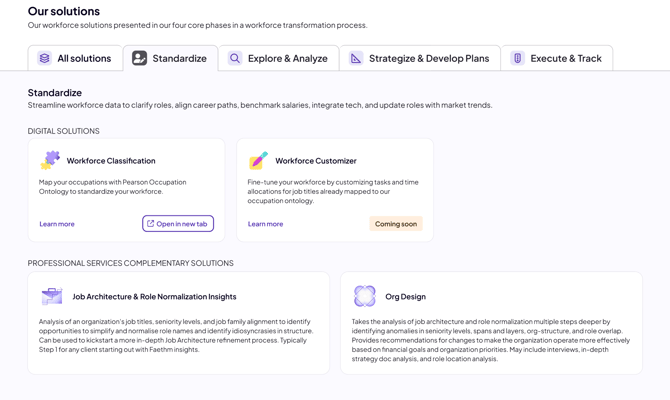
1. Standardize – Align and structure your workforce data
In this phase you:
- Cleanse and normalise job data (mapping roles to the occupations ontology)
- Classify and structure workforce data so it’s consistent and usable
- Establish foundational data architecture (job roles, tasks, skills, levels)
Why: Without a solid data/role base, downstream insights will be inconsistent or misleading. This aligns with the “foundation” concept found across transformation frameworks.
What you’ll do on the platform:
-
Use the Workforce Classification tool to map job titles to standard roles
-
Use the Workforce Customizer to define task‑time profiles and job‑task logic
-
Upload data, verify accuracy, and prepare your workforce for deeper analysis
2. Explore & Analyze – Visualise trends and identify skill gaps
In this phase you:
- Analyse your structured data to visualise workforce trends, skills supply & demand, and critical roles
- Use dashboards and analytics to uncover where the biggest gaps or opportunities lie
- Begin to build scenario modelling for future workforce states
Why: Insight drives action. According to research, companies using analytics in workforce planning gain agility and are better at anticipating change.
What you’ll do on the platform:
- Use the Workforce Snapshot to explore workforce‑wide data
- Dive into Workforce Labs for experimental insights
3. Strategize & Develop Plans – Model scenarios and prepare for future impact
In this phase you:
- Translate insights into strategic workforce plans
- Model future states (technology impact, workforce transition, role redesign)
- Develop roadmaps, capability uplift plans and role transformation strategies
Why: With clarified data and meaningful insights, you’re now positioned to plan proactively. Research emphasises that agility and strategic alignment are key in successful transformations.
What you’ll do on the platform:
- Use the Impact of Tech (Tableau) tool to understand automation/augmentation risks
- Engage supporting services (Workforce Technology Impact, Strategic Workforce Planning Strategy, Role Redesign & Optimization)
- Build actionable workforce roadmaps, capability uplift schedules and role transition frameworks
4. Execute & Track – Take action and monitor progress
In this phase you:
- Implement your plans — role redesigns, upskilling, redeployment, new hiring
- Monitor progress via dashboards, KPIs, and feedback loops
- Refine and adjust your approach based on real‑time data
Why: Without execution and tracking, you risk losing value and changes may not be sustained.
What you’ll do on the platform:
- Use Workforce Customizer (coming soon) for role redesign and mapping
- Monitor skill development and role changes via supporting services (Credentialing Strategy, TalentLens Assessments, Skills & Competency Framework Development)
- Use built‑in dashboards and run regular check‑ins to refine your approach
Summary
Transforming your workforce is a journey. The four phases provide a repeatable, logical path from cleansing and organising your data (Standardize), through insight generation (Explore & Analyze), strategic planning (Strategize & Develop Plans), to implementation and monitoring (Execute & Track). Each phase builds on the previous one and, together, they set you up for sustainable change.
As you move through the phases, you’re not just reacting to change — you’re anticipating, planning, and acting. That’s what makes the transformation not just necessary, but impactful.